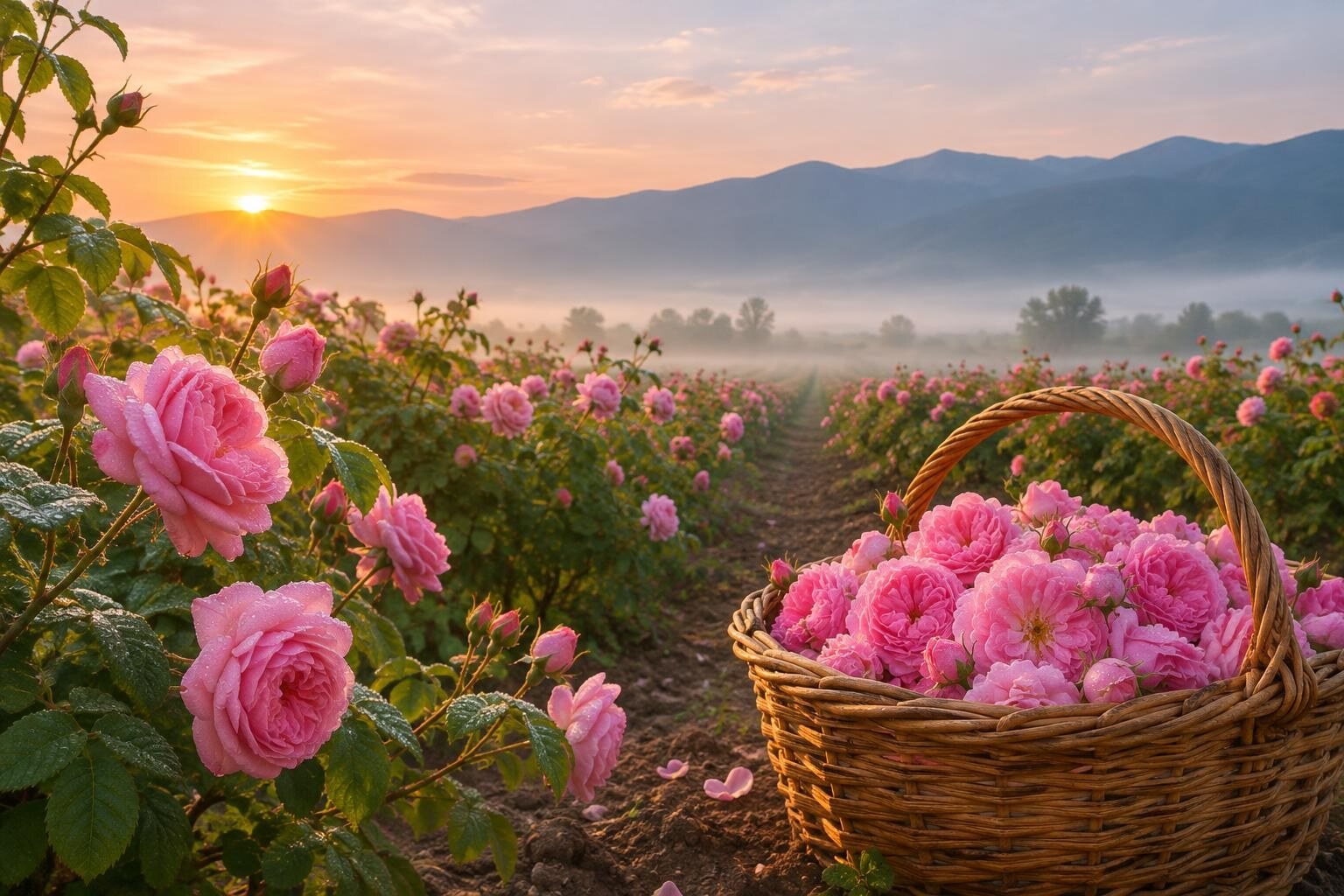
In late May, in a valley in the middle of Bulgaria, pickers walk the rows before breakfast and snap pink flowers into sacks. They work early because the scent is strongest in the cool of the morning, and it fades as the day warms. Those flowers become rose oil, one of the oldest and most valuable materials in perfume. Once you can pick it out, you will notice it far beyond the bottles marked “rose.”
The two roses perfumers use
There are thousands of garden roses, but perfume relies mostly on two. The damask rose, Rosa damascena, is grown widely in Bulgaria and Turkey, and also in places such as Iran and India. The cabbage rose, Rosa centifolia, is grown mostly in Morocco, France and Egypt. The damask rose smells bright, a little lemony and spicy; the cabbage rose is softer and more honeyed.
Every drop of real rose oil starts as a flower picked by hand, usually before the sun is high.
Bulgaria’s Rose Valley, around the town of Kazanlak, has given its name to a whole style of rose oil. Turkey grows on a similar scale: dsm-firmenich, one of the big fragrance makers, says each country grows around 13,000 metric tons of rose petals a year.
From petals to oil
There are two main ways to turn rose petals into a perfume material, and they smell different.
Rose otto (also called rose oil or attar of roses) is made by distillation: the petals are heated with water and steam, the fragrant oil travels with the steam, and when the steam cools the oil separates out. It is fresh, bright and very expensive, because the yield is tiny. dsm-firmenich puts it at about 3,500 kilograms of flowers for one kilogram of oil.
Rose absolute is made with a solvent, a liquid that washes the fragrant material out of the petals. That first gives a waxy paste called a concrete, and washing the concrete again with alcohol gives the absolute. It takes far fewer flowers, about 350 kilograms for a kilogram of concrete by dsm-firmenich’s figures, and it smells deeper, sweeter and closer to a rose in a vase.
Much of what makes a rose smell like a rose comes down to a handful of molecules. dsm-firmenich names citronellol, nerol and geraniol as the main parts of damask rose oil, and cabbage rose absolute is more than half phenylethyl alcohol. As we saw in Lesson Three, perfumers can make many of these in a lab. That is why an affordable perfume can still smell convincingly of roses, and why expensive ones mix lab-made materials with real rose to make it last and shine.
How rose shows up in a perfume
Rose is a team player. It usually sits in the heart, the middle stage of a perfume we met in Lesson One, and it can lean fresh, sweet, dark or spicy depending on what surrounds it. Two easy-to-find examples show the range. Chloé Eau de Parfum, the brand’s signature, lists peony at the top, rose petals and magnolia in the heart, and cedar and ambergris in the base: a clean, powdery rose. Tom Ford’s Café Rose lists Turkish rose and Bulgarian rose with coffee: the same flower, much darker. Spray them side by side and you will understand how much the company a rose keeps changes it.
From the Archive
Bulgaria’s rose fields have not always been safe. Planting in the Valley of Roses peaked around 1910 at about 9,000 hectares. After the fall of communism in 1989, only 1,000 to 1,500 hectares were still planted, and the growers have since built back to around 4,500 hectares, according to a 2022 report in AramcoWorld.
At the Counter
Spray Chloé Eau de Parfum on one paper strip and Tom Ford Café Rose on another, and label them. Smell each right away, then again after ten minutes. Try to find the rose in both: in Chloé it sits with flowers and soft powder; in Café Rose it sits with coffee and spice. Then put your favorite on your wrist and wear it for the afternoon.
Sources
More on Chloé 3dsm-firmenich 6Nordstrom 5Tom Ford 7
Try this
Find a real rose, or a bottle of rose water from the grocery store, and smell it. Then smell any rose perfume you own or can test. Notice what the perfume adds that the flower doesn't have, maybe powder, fruit, wood or sweetness. That gap is the perfumer's work.
Further reading & listening
Test your nose
Keep reading
The School, Lesson Eleven · Nov 25
Frankincense, the Resin That Built a Trade Route
The School, Lesson Ten · Nov 23
Five Hundred Bottles Before Breakfast: How Perfumers Are Trained
The School, Lesson Nine · Nov 20