This morning’s lead story is about computers hunting for new perfume ingredients. Today’s lesson is about the opposite end of the business: one of the oldest, slowest and most loved materials in the whole palette. Walk down any fragrance aisle and you will find vanilla in bestseller after bestseller. Valentino puts Bourbon vanilla among the key notes of Donna Born in Roma, and Lancôme sells La Vie Est Belle with “Vanilla Bean & Iris” right in its name.
In Lesson One you met base notes, the deep, slow part of a fragrance that you smell hours after spraying. Vanilla is the classic base note: warm, sweet and soft. In Lesson Three you learned that a lab-made version, vanillin, has existed since the 1870s. Today we go to the source.
Every vanilla bean grown today owes something to a twelve-year-old's thumb.
An orchid with a one-day flower
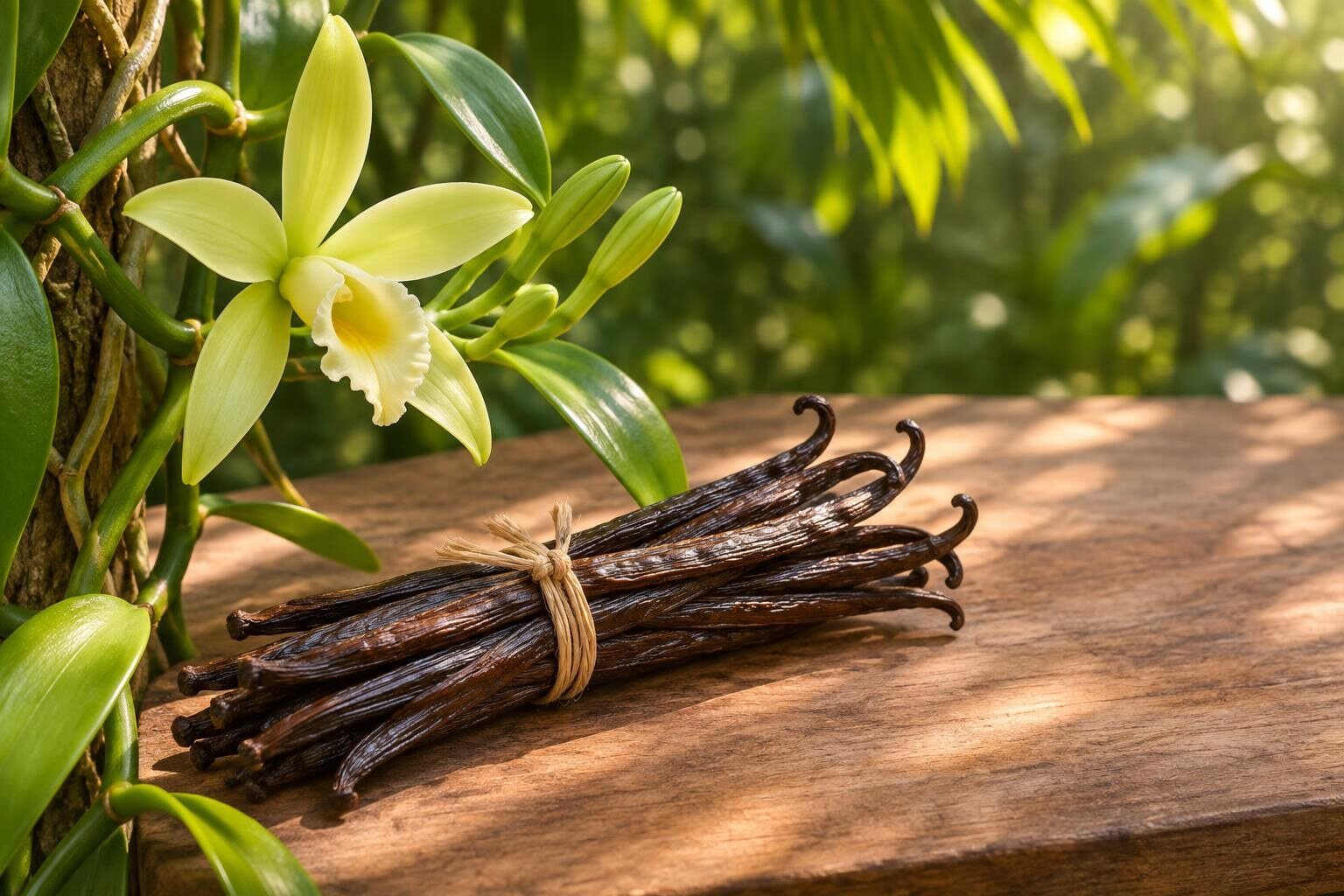
Vanilla is the cured seed pod of an orchid, mostly a species called Vanilla planifolia, which grew wild around the Gulf of Mexico and down into South America. The Totonac people of what is now Veracruz, Mexico, were among the first to farm it, at least as early as 1185, and used it to scent temples as well as food.
The catch is the flower. Each blossom opens for about a day, and a flap inside it keeps its own pollen away from the part that needs it. In the wild only certain bees manage the job, and even there success is rare. Take the vine anywhere else in the world and it will grow happily and almost never give you a single bean.
From the Archive: the boy who cracked it
That was exactly the problem French colonists faced on the Indian Ocean island of Réunion, then called Île Bourbon, after they brought vanilla vines there in the early 1800s. A Belgian botanist, Charles Morren, had published a way to pollinate the flowers by hand in 1837, but it was too slow to pay.
In 1841 a twelve-year-old enslaved boy named Edmond, held on a plantation in Sainte-Suzanne, found a better way. Using a thin stick to lift the flap and his thumb to press the pollen into place, he could pollinate a flower in moments. It is the same method growers use today, and nearly all the world’s vanilla is still pollinated by hand. Every vanilla bean grown today owes something to a twelve-year-old’s thumb. Réunion became for a time the world’s biggest supplier, and the technique traveled to Madagascar, which leads the world today. Edmond took the surname Albius after slavery ended in French colonies in 1848; he never received the reward that local admirers asked for on his behalf, and he died poor in 1880. The name “Bourbon vanilla” comes from the island’s old name, not from whiskey.
Months of patience
A pollinated flower becomes a green pod that needs months on the vine to mature, and each pod is picked by hand as it ripens. A fresh green pod barely smells of vanilla at all. The smell is made afterward, in curing: the pods are killed, often with a quick dip in hot water; then “sweated” for seven to ten days, kept warm and wrapped until they turn brown; then dried slowly in sun and shade for three to four weeks; and finally rested in closed boxes for five to six months. A finished bean holds, on average, about 2.5 percent vanillin.
All that hand labor is why vanilla is the second most expensive spice in the world by weight, after saffron. It is also why the price swings wildly when the weather turns. Madagascar grew 42 percent of the world’s raw vanilla in 2023, according to United Nations figures, so a single cyclone there can move the market; prices reached roughly $500 a kilogram in 2004 and again in 2017.
Real vanilla, vanillin and your perfume
Vanillin is the star molecule in a vanilla bean, but it is not the whole show. Researchers have identified 171 aromatic compounds in real vanilla, and that crowd gives a natural extract its depth: hints of smoke, dried fruit, wood and even a little spice. Lab-made vanillin is cleaner and sweeter, far cheaper and perfectly consistent, which is why most vanilla flavor in the world is synthetic; one estimate puts it at about 95 percent of vanilla-flavored products.
Perfumers use both. Natural vanilla extracts show up in prestige fragrances when a brand wants that dark, boozy richness, and vanillin and its stronger cousin ethylvanillin do the heavy lifting in countless others. Neither is the “real” one in any way that matters on your skin. When a brand names Bourbon or Madagascar vanilla, it is telling you about the character it was after, a deeper and more rounded vanilla rather than a sugary one.
At the Counter
Because vanilla is a base note, it is shy at first. Next time you test a vanilla fragrance, spray it on your wrist and smell it right away, then again after an hour. The first sniff is mostly top notes; the vanilla you are paying for shows up later. Buy on the one-hour smell, not the first one.
Sources
- Wikipedia: Vanilla (Totonac farming since at least 1185; one-day flowers; curing stages and durations; 2.5% vanillin; second most expensive spice; 171 aromatic compounds; ~95% estimate; 2004 and 2017 price spikes; FAOSTAT 2023 production)
- Wikipedia: Edmond Albius (1841 hand-pollination at age 12; Morren 1837; abolition 1848; died 1880)
- National Geographic: The Little Boy Who Should’ve Vanished, but Didn’t
- BBC: How a 12-year-old boy made vanilla a global spice
- FAOSTAT: crop production data
- Sephora: Valentino Donna Born in Roma (Valentino’s key notes: blackcurrant, jasmine grandiflorum, Bourbon vanilla)
- Ulta Beauty: Lancôme La Vie Est Belle Eau de Parfum with Vanilla Bean & Iris
More on La Vie Est BelleLancôme 5Sephora 6Ulta Beauty 13Valentino 2
Try this
Find a bottle of pure vanilla extract and one of imitation vanilla in a kitchen or grocery store. Put a drop of each on separate paper towels, label them, and smell each one right away and again after ten minutes. Notice which smells simply sweet and which smells darker, woodier and more complicated.
Further reading & listening
Test your nose
Keep reading
The School, Lesson Ten · Nov 23
Five Hundred Bottles Before Breakfast: How Perfumers Are Trained
The School, Lesson Nine · Nov 20
The Sequel Problem
The School, Lesson Eight · Nov 18