
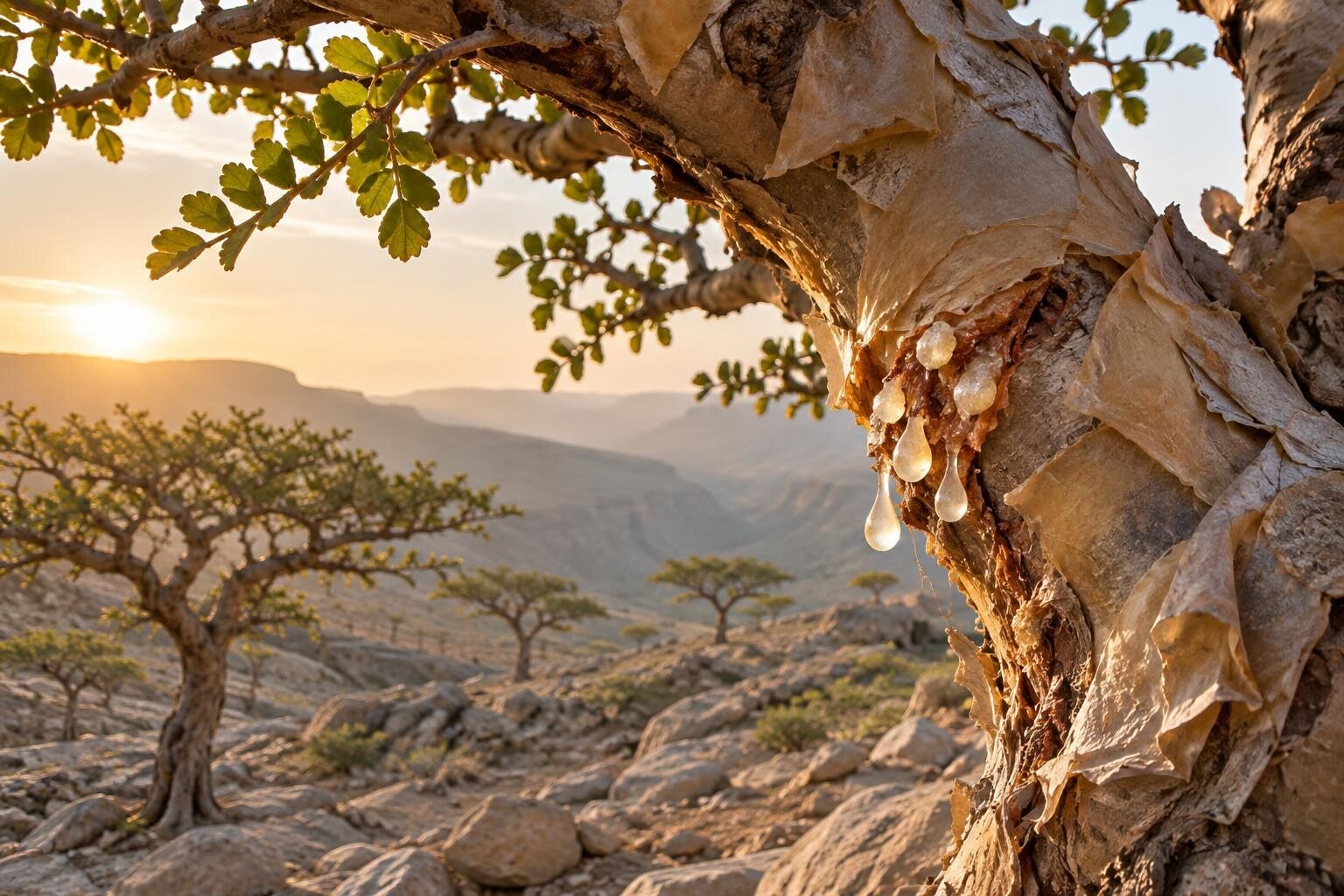
A tree in the dry hills of southern Arabia gets a small cut in its bark, and over the following days it bleeds a milky sap that hardens into pale, glassy lumps. People have been collecting those lumps for thousands of years, burning them in temples, trading them across deserts and, today, putting them in perfume. This is frankincense, and once you know what it smells like, you will find it in more bottles than you expect.
It is a resin, not a flower or a fruit, and that changes everything about how it behaves on skin.
Frankincense rarely shouts. It tends to sit in the base of a perfume as a dry glow.
What frankincense is
Frankincense is the hardened resin (the sticky sap a tree makes to seal a wound) of trees in the Boswellia family, which grow in the Arabian Peninsula and the Horn of Africa. Perfumers often call it olibanum, an older name for the same material, so you will see both words on note lists. The lumps are called tears because of their shape. On their own they smell faintly of lemon peel and pine; warmed or burned, they give off the soft, smoky, slightly sweet air most people know from a church or a temple.
In Lesson Three we met the difference between natural materials and lab-made ones. Frankincense is firmly on the natural side: every drop of its oil starts as resin from a tree.
Where it grows, and why Oman matters
Some of the most prized frankincense comes from the Dhofar region of southern Oman, where the species Boswellia sacra grows on rocky ground watered by a seasonal monsoon. Four sites there, together called the Land of Frankincense, have been on UNESCO’s World Heritage list since 2000. One of them, Wadi Dawkah, is a valley holding thousands of wild frankincense trees, and Oman’s own press notes the resin has been harvested in the region for more than 4,000 years.
Since 2022, the Omani perfume house Amouage has looked after Wadi Dawkah under an agreement with Oman’s Ministry of Heritage and Tourism, training harvesters and studying the trees. In 2024 the house introduced a frankincense essential oil distilled from the valley’s resin, made with the ingredient company dsm-firmenich. That is unusual: most perfume houses buy their raw materials from suppliers rather than tending the trees themselves. And this week, as our news pages report, Amouage is even serving frankincense ice cream in the valley.
From tears to oil
The harvest is done by hand. A harvester nicks the bark, the tree seeps resin to close the cut, and the resin dries in the open air before it is gathered. The trees are given rest between harvests, which is why careful producers talk about letting them recover.
For perfume, the tears go into a still, where steam carries the fragrant oil out of the resin and is then cooled back into liquid. That essential oil is the bright, lemony, peppery side of frankincense. Perfumers can also use a resinoid, a thicker extract made with a solvent, which keeps more of the deep, balsamic warmth. Many modern perfumes add lab-made materials alongside the natural oil to make the incense effect last longer or smell cleaner.
How it smells in a perfume
Frankincense rarely shouts. It tends to sit in the base or middle of a perfume as a dry glow, lifting darker notes like rose, patchouli or woods and keeping sweet notes from turning sticky. Its lemony top edge means it can also feel surprisingly fresh at first spray.
Parfumo, the fragrance database, lists frankincense among the notes of several perfumes you can find at department stores, among them Frédéric Malle’s Portrait of a Lady, a rich rose, and Diptyque’s Eau Duelle Eau de Parfum, a vanilla. Both use it as a quiet support rather than the star. For a perfume where it is the whole show, Amouage’s Interlude Man is a famous example, also on Parfumo’s frankincense list.
From the Archive
The Gospel of Matthew names frankincense among the three gifts the Magi brought to the infant Jesus, alongside gold and myrrh, a sign of how valuable the resin was in the ancient world. It traveled overland and by sea from southern Arabia to the cities of the Mediterranean, and the routes it moved along are part of what UNESCO protects in Oman today.
At the Counter
Ask for a tester of a rose or a vanilla perfume that lists frankincense or olibanum, spray a paper strip, and smell it right away, then again after twenty minutes. The first smell is often bright and peppery; the later one is where the soft, smoky warmth shows up. Then, if you still like it, put it on your wrist.
Sources
- Wikipedia: Frankincense
- UNESCO: Land of Frankincense
- Oman Observer: Wadi Dawkah, Oman’s leading model for sustainable practices
- Oman Observer: Amouage introduces Wadi Dawkah frankincense oil
- FairWild: Amouage earns certification for Wadi Dawkah
- Parfumo: perfumes with frankincense
- The Gospel of Matthew, chapter 2, verse 11
More on Amouage 2dsm-firmenich 6Frédéric Malle 2
Try this
Find a frankincense or plain incense stick at home or in a shop and smell it unlit, then smell the air a minute after someone lights it. Notice how the cold smell is lemony and piney, and the warm smoke is softer and sweeter. That is the same split you will meet in a perfume.
Further reading & listening
Test your nose
Keep reading
The School, Lesson Twelve · Nov 27
Rose in Perfume: How 3,500 Kilos of Flowers Become One Kilo of Oil
The School, Lesson Ten · Nov 23
Five Hundred Bottles Before Breakfast: How Perfumers Are Trained
The School, Lesson Nine · Nov 20