
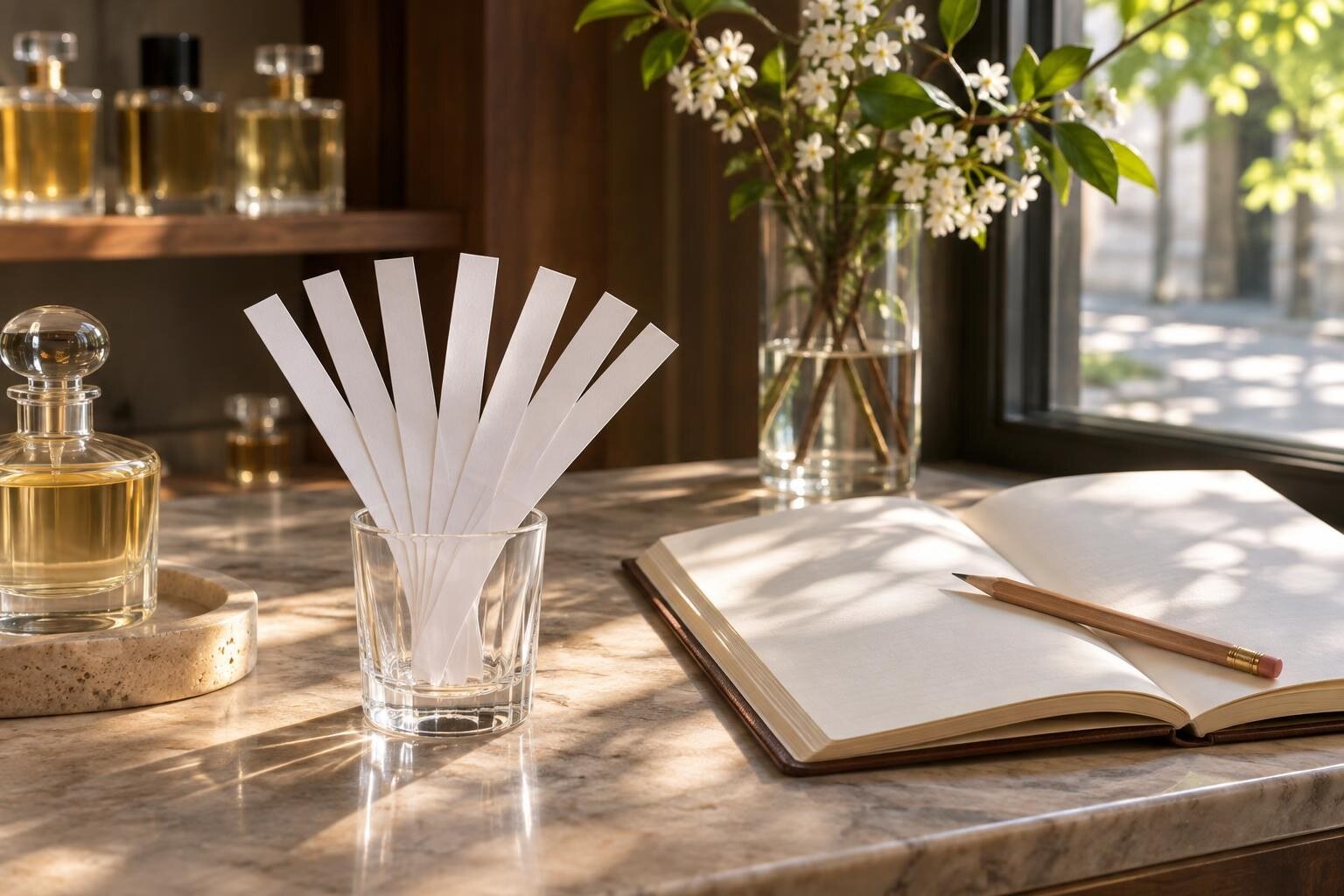
It is the second week of November, the early holiday sales are on, and a great deal of perfume is about to be bought in a hurry. Most of the regret that follows starts the same way: a quick spray on a paper strip, a sniff, a yes, and a bottle that smells nothing like that strip by dinner.
Testing a fragrance well is not hard. It just takes longer than the counter would like. Here is how to do it.
The fragrance you will live with is the one on your wrist at hour four, not the one on the paper at second ten.
Paper is for narrowing, not deciding
Those white cards at the counter are called smelling strips or blotters, and they are useful. They let you try many scents without covering your arms, and they show you the shape of a fragrance quickly. Use them to cut a long list down to two.
Three habits make them work better. Write the name on each strip the moment it is sprayed. Wait a few seconds before you smell, because the first blast is mostly alcohol. And remember that paper has no warmth and no oils, so it shows you a sketch of the fragrance, not the finished picture.
Your nose gets tired, and that is normal
Smell the same thing for a few minutes and your nose quietly stops reporting it. Scientists call this olfactory fatigue, or adaptation. It is why you cannot smell your own home but notice a friend’s the second you walk in. At a perfume counter it means the fifth fragrance you try is being judged by a nose that has already worked hard. Our rule of thumb is three or four per visit, with a walk outside in fresh air if you want to try more.
From the Archive: the coffee jar
Many counters keep a little jar of coffee beans to reset your nose between sprays. In 2011, psychology professor Alexis Grosofsky of Beloit College in Wisconsin and two of her students put the jar to the test. Volunteers smelled three fragrances, then sniffed coffee beans, lemon or plain air, then tried to pick out a fourth, new fragrance. The coffee and the lemon did no better than air. The researchers concluded the two had no special refreshing power. It was one small study, with 63 people, so it is not the last word, but the jar runs more on habit than on evidence. Time and fresh air are the reset you can count on.
Skin is the real test
Take your two finalists and put one on each wrist, or one on the inside of each elbow. One spray each is enough. Do not rub your wrists together; brands commonly advise against it, because the friction and warmth hurry along the light top notes. Then leave the counter. Your skin’s warmth, oils and even what you ate shape how a fragrance smells, which is why the same perfume can smell different on you than on a friend.
Here is why that matters, using a fragrance most people have met: Lancôme’s La Vie Est Belle, which happens to be on sale this week. Lancôme lists pear and blackberry on top, iris, orange blossom and jasmine in the heart, and patchouli at the base with a vanilla accord. On a strip at the counter you mostly meet the fruit. The warm, sweet patchouli and vanilla that its fans love takes hours on skin to fully arrive.
Give it four hours
Lesson One called these the three acts of a fragrance, and testing is about seeing all three. Check your wrists at about ten minutes, when the opening has settled; at about an hour, when the heart is in charge; and at about four hours, when the base has taken over. Write one word for each wrist each time. Those words will tell you more than any salesperson can. The fragrance you will live with is the one on your wrist at hour four, not the one on the paper at second ten.
At the Counter
Ask for a sample to take home. A department store at two in the afternoon is not your life. Wear the sample on an ordinary day, at work or out in the cold, and if you still like it that evening, you have your answer, and you can buy the full bottle knowing you will use it.
Sources
- First Nerve (Avery Gilbert): The Coffee Bean Meme (May 10, 2011 post on the Grosofsky study in Perceptual and Motor Skills, sample size)
- Perfume Shrine: Myth Busting Coffee Beans (quotes Beloit College’s announcement of the study)
- Wikipedia: Olfactory fatigue
- NBC Select (brand advice against rubbing fragrance into skin)
- Lancôme: A guide to La Vie Est Belle (notes)
More on La Vie Est BelleLancôme 5
Try this
Pick two fragrances you are curious about, one on each wrist, one spray each, no rubbing. Write one word for each at ten minutes, one hour and four hours. At the end of the day, read your six words and see which wrist you would rather have had all along.
Further reading & listening
Test your nose
Keep reading
The School, Lesson Ten · Nov 23
Five Hundred Bottles Before Breakfast: How Perfumers Are Trained
The School, Lesson Nine · Nov 20
The Sequel Problem
The School, Lesson Eight · Nov 18