When today’s news mentions student perfumers, it is worth asking what a perfumer actually studies. The answer is less glamorous and more impressive than you might think: years of smelling, one material at a time, until hundreds of them can be named blind.
Grasse, 1946: a school for noses
The best-known training program began in 1946, when the French perfumer Jean Carles opened a school at the fragrance company Roure in Grasse, the perfume town in southern France. Roure is now part of Givaudan, the world’s largest fragrance maker, and the school, now called the Givaudan Perfumery School, sits in Argenteuil, just outside Paris. Carles himself composed perfumes still talked about today, including the original Miss Dior of 1947, which he made with Paul Vacher.
The goal is not to remember that a bottle is rose. It is to know which rose, from where.
Fragrance companies, not universities, train most of the perfumers behind the bottles you know. The big makers run their own schools, and France also has public programs. Places are few, and students are hired with the expectation that they will one day create for the company’s clients.
The Carles method
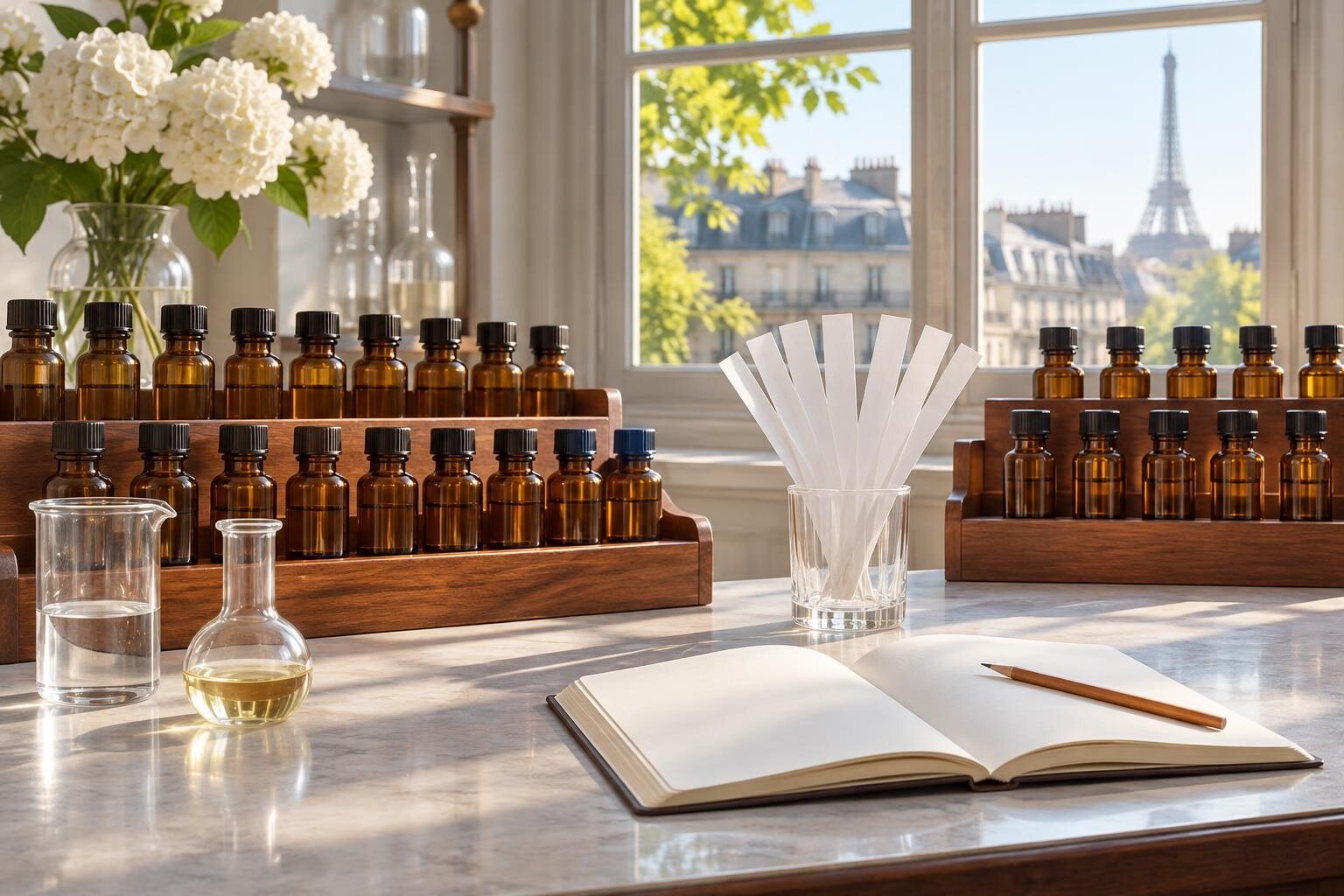
Carles’s great idea was an order for learning. He laid out about 60 materials in a table, one column per family, such as floral or woody. Students first smell across the columns, where the differences are big and easy, like lemon against cedar. Only then do they work down a column, comparing close cousins such as lemon and bergamot, where the differences are small and hard. The drawing below shows the idea with a sample of our own choosing.
The goal is not to remember that a bottle is rose. It is to know which rose, from where, and how it differs from a lab-made rose material, which is the kind of judgment Lesson Three, on natural and lab-made materials, prepared you for.
Five hundred smells, then the classics
A profile of the Givaudan school in the trade magazine Perfumer & Flavorist described the scale of the job. Students memorize about 500 materials, roughly 350 made in the lab and 150 from nature, in about four to seven months, smelling for eight hours a day. Those who can’t pass the exam leave the program. Each student invents a personal memory system; there is no single trick.
The next step is accords, small blends of a few materials built to suggest one smell, such as lily of the valley, a flower whose scent can’t be extracted and must be imitated. After that, students spend much of a year copying famous formulas, the way art students copy old masters, to learn how great perfumes are built. In the program that magazine described, the whole course ran four years, the last spent working inside the company.
Why it matters at the counter
That training explains why perfumers talk about notes the way they do. When a brand lists bergamot rather than just citrus, someone was trained to tell the two apart. It also explains why flankers and reformulations can smell so close to the original: the people making them spent a year learning to copy.
You don’t need 500 bottles to borrow the method. Smell two very different things first, then two similar ones, and say out loud what separates them. Your nose gets better the same way a student’s does, by comparison rather than by sniffing one thing harder.
From the Archive
Late in his life, Jean Carles lost his sense of smell. According to accounts of his career, he kept composing from memory, and his son Marcel smelled the work for him, keeping the secret. He is often compared to Beethoven, who kept writing music after losing his hearing.
Sources
More on Dior 3Givaudan 7
Try this
Take a lemon and a cinnamon stick and smell them one after the other: name one difference. Then smell the lemon against an orange peel and name one difference. Notice how much harder the second pair is; that is the Carles method at your kitchen counter.
Test your nose
Keep reading
The School, Lesson Nine · Nov 20
The Sequel Problem
The School, Lesson Eight · Nov 18
Spray, Then Hands Off
The School, Lesson Seven · Nov 16