
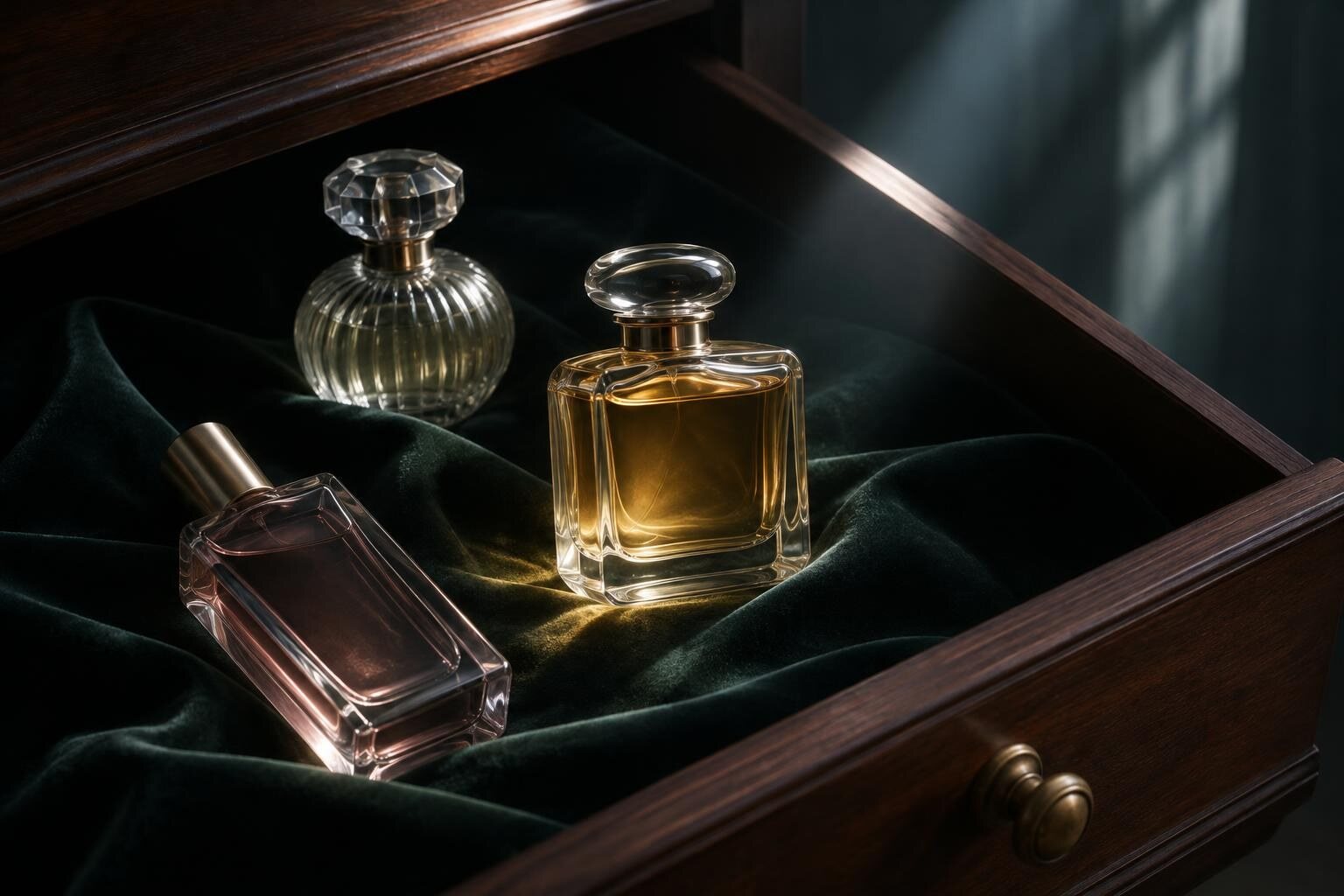
Loewe’s new $320 Moonlight bottle, our lead story this morning, comes with a line of advice on its product page that could go on almost every bottle ever sold: keep it somewhere cool and dry, away from light and heat. Lancôme gives its customers the same advice. It is the least glamorous sentence in perfume, and it is the one that decides whether a bottle still smells right in three years.
What happens inside the bottle
A perfume is mostly alcohol carrying a blend of aroma molecules. Many of those molecules are delicate. Oxygen reacts with them, a process called oxidation, the same family of change that browns a cut apple. Heat speeds up every one of those reactions. Light, especially the ultraviolet part of sunlight, can break fragile molecules apart.
Darkness, a tight seal and a steady temperature: the recipe has not changed in two thousand years.
The first part of a fragrance to suffer is usually the top, the bright opening notes we met in Lesson One. Citrus is the classic casualty. That is why a bottle kept badly often opens sharp, flat or a little sour, while the deeper base notes hold on longer.
From the Archive: two thousand years in the dark
In 2019, workers digging a swimming pool in Carmona, in southern Spain, broke into a Roman family tomb from the first century. Inside one burial urn was a small bottle carved from quartz, a rare luxury in Roman times, still sealed with a stopper of dolomite and bitumen, a tar-like substance. Chemists at the University of Córdoba analyzed the solid residue inside and reported in the journal Heritage in 2023 that it had been a perfume made with patchouli in a vegetable oil base. The airtight seal is what preserved the evidence. Darkness, a tight seal and a steady temperature: the recipe has not changed in two thousand years.
Air is the enemy you let in
Every time you spray, a little air replaces the liquid that left. Two molecules show up on a great many ingredient labels: limonene, which smells of citrus peel, and linalool, which smells soft and floral. Both appear on the label of Loewe’s Moonlight, for one. Swedish dermatology researchers led by Ann-Therese Karlberg showed in the 1990s that limonene changes on long exposure to air, and later patch-test studies found the oxidized forms of both molecules can irritate or sensitize skin more than the fresh ones. A bottle you use and cap is not a hazard. A bottle left open, or nearly empty and stored warm for years, is one to retire.
The worst shelf in the house
The bathroom is where most people keep perfume, and it is the worst choice: every hot shower brings steam and a swing in temperature. A sunny windowsill puts light straight through clear glass. A car runs hot in summer and freezing in winter. The good spots are dull ones: a dresser drawer, a closet shelf away from outside walls and heaters, or the bottle’s own box, which is a light shield you already paid for. Some people keep perfume in the refrigerator. That can work, but steadiness matters more than cold, so a bottle that goes in and out of the fridge every morning may be worse off than one in a drawer.
At the Counter
When you buy a bottle, keep the box. Do not let it go in the bag at the register and then into the recycling. Store the bottle back in its box between uses, and you have done most of what any perfumer would ask of you.
Sources
- Loewe Perfumes: Moonlight (storage instructions and ingredient list)
- Lancôme: This Is How You Should Be Storing Your Perfume
- Cosano, Román, Lafont and Ruiz Arrebola, “Archaeometric Identification of a Perfume from Roman Times,” Heritage, 2023
- Science News: An old perfume bottle reveals what some ancient Romans smelled like
- Karlberg, Magnusson and Nilsson, “Air oxidation of d-limonene creates potent allergens,” Contact Dermatitis, 1992
- Matura et al., “Selected oxidized fragrance terpenes are common contact allergens” (Lund University)
Try this
Tonight, find every bottle you own. Anything on a bathroom shelf, a windowsill or in the car moves to a drawer or back into its box, capped tight. In a month, spray one and notice whether the opening still smells as bright as you remember.
Further reading & listening
Test your nose
Keep reading
The School, Lesson Ten · Nov 23
Five Hundred Bottles Before Breakfast: How Perfumers Are Trained
The School, Lesson Nine · Nov 20
The Sequel Problem
The School, Lesson Eight · Nov 18