
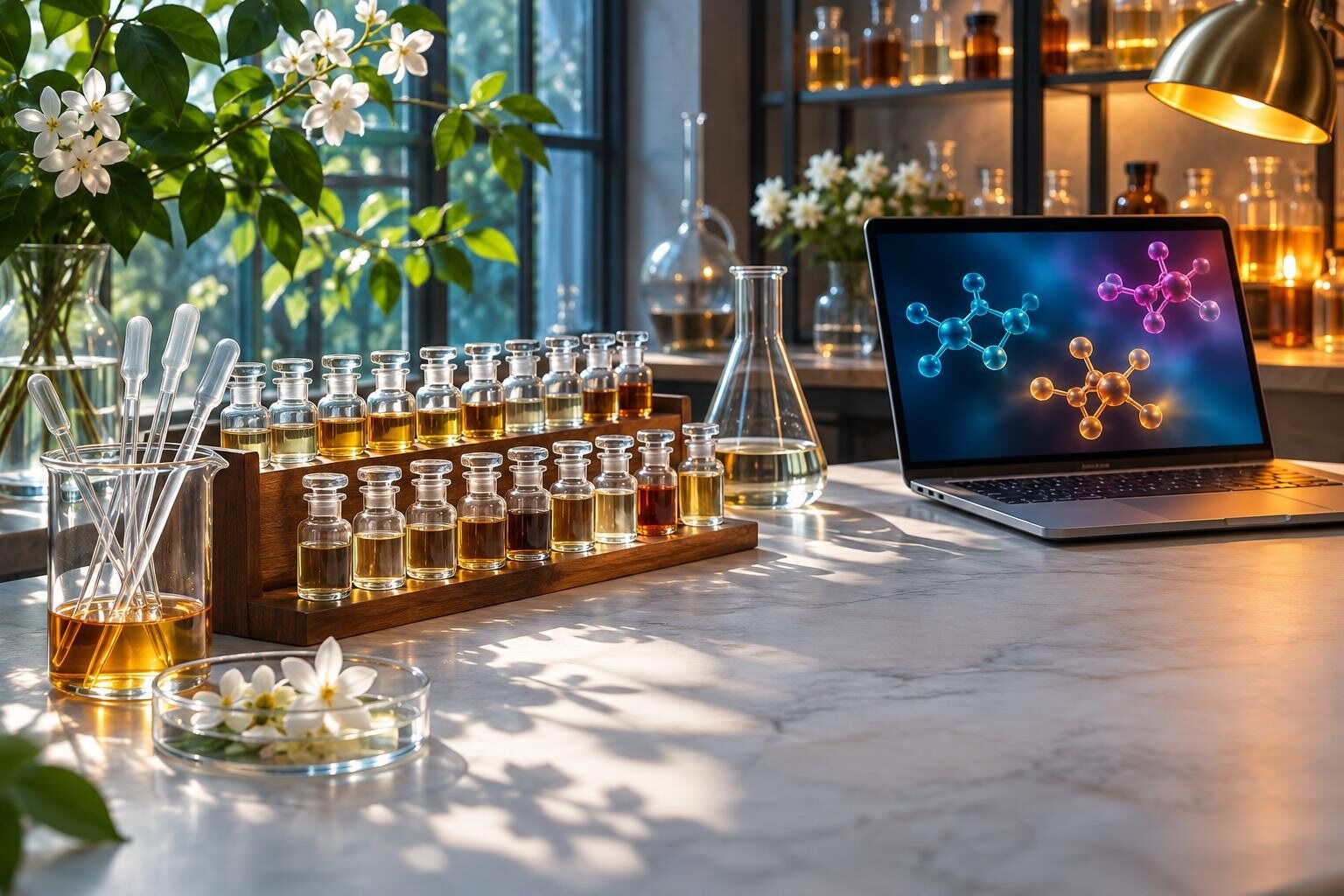
The newest member of the perfume lab doesn’t have a nose. According to a report from Agence France-Presse published this morning, the biggest names in fragrance are now using artificial intelligence to suggest ingredient pairings, check regulations and find replacements for materials the industry has retired, and one of them says the technology is shaving close to a third off the time it takes to bring a scent to market.
At the center of the report is Estée Lauder, the company behind Jo Malone London, Kilian Paris, Le Labo and Tom Ford Beauty. Its fragrance innovation center in Paris, which opened in 2025, uses AI alongside its perfumers, and Lucas Nanini, the group’s vice president for fragrance innovation, told AFP he tries out some of the resulting formulas on visitors.
The machine can propose a thousand pairings; it still takes a nose to decide which one is worth wearing.
What the machines are actually doing
Nanini described the job in terms of “paradoxes”: problems where two goals pull against each other. His example was an oil that has to feel rich yet still be light enough to spray. Working out that kind of balance by hand can take a perfumer years of trial and error; the software narrows the search.
The less romantic use may matter just as much. Perfumers work from a palette of more than a thousand ingredients, and every country sets its own rules on which are allowed and in what amounts. Nanini told AFP he can now check a single ingredient against a country’s limits in one click. AI is also being used to hunt for molecules that can stand in for animal materials such as civet, a musky secretion once common in perfume that the industry has largely abandoned after animal-welfare protests.
Faster from idea to counter
International Flavors & Fragrances, the American company that creates scents for many of the brands you know, put a number on it: AI cuts 25 to 30 percent of the time needed to develop and produce a perfume, according to the company’s estimate reported by AFP. IFF built its tools on decades of its own data. One of them, used by IFF perfumer Tanguy Guesnet, looks at the molecules inside an ingredient and suggests others that share them; mint, for instance, contains a compound called menthone, so the tool can point to other materials that carry it too. Guesnet told AFP that some suggestions look obvious and some look strange, and that the strange ones are the point. AFP also reported that Givaudan of Switzerland and Robertet of France have invested heavily in tools to discover new molecules.
The case for the human nose
Not everyone is sold. Guillaume Teule, co-founder of the French house Helius, told AFP he keeps his own vision, and argued that the interesting moments in a perfume come from clashes between ingredients that only a person knows how to use. His proof was Thierry Mugler’s Angel, the 1992 fragrance that put sweet, dessert-like notes at the center of a perfume and started the gourmand craze. He doesn’t believe any AI would have suggested it.
That is the honest middle of this story. The machine can propose a thousand pairings; it still takes a nose to decide which one is worth wearing. For you, the practical effect is likely to be more launches arriving faster, more lab-made replacements for animal and restricted materials, and the same old rule at the counter: judge it on your skin, not on how it was made.
Sources
More on Estée Lauder 4Givaudan 7IFF 3Jo Malone 4Mugler 2Tom Ford 4
Further reading & listening
Keep reading
New Talent · Nov 23
Oriflame's Student Perfumers Finish the Job: Prima Vanilla and Moon Mood Complete Top Scents

Back From the Vault · Nov 22
Kim Kardashian Promises a Bride One More Bottle of KKW Gardenia

Trade Show · Nov 22